The Spey Catchment Initiative (SCI) was established in 2010 to advance key actions from the original 2003 Spey Catchment Management Plan, now guided by the 2023-2030 plan. As a Scottish Charitable Incorporated Organisation (SCIO), SCI is managed by a steering group representing 14 public, private, and third-sector partner organisations. Our mission is to create a sustainable, climate-resilient, and thriving environment for wildlife and communities throughout the Spey Catchment. We engage a wide array of stakeholders, including landowners, managers, recreational users, and communities, addressing various environmental issues.
Over the years, SCI has delivered numerous successful projects focusing on riparian woodland creation, river restoration, and removing barriers to fish migration. Our recent efforts have upscaled to sub-catchment landscape projects addressing climate change and biodiversity loss, while continuously involving local communities. Significant achievements include the Allt Lorgy River Restoration Project, which earned the 2020 UK Rivers Prize. Our partnerships with various environmental authorities, industrial entities, and local councils drive our collaborative approach, ensuring the Spey Catchment remains a beacon of biodiversity and community resilience.
Objectives of the project
The main objective of the Robo-cutter Riparian Regeneration Trials is to increase the amount and diversity of riparian shrub and tree cover along the banks of watercourses. The trial employed mechanical cutting of rank vegetation such as dense heather using the flail, to form a seed bed for colonisation by other trees and plants which are currently struggling to establish. This aims to enhance biodiversity and climate resilience by:
- Providing more and better-connected woodland habitat
- Improving in-stream habitat for fish and other aquatic life
- Providing shading to control water temperature
- Slowing the flow of water out of the catchment to mitigate flood and drought impacts
Any challenges or obstacles to the project and how were these over come
Weather conditions posed some challenges, as the work needed to be completed before the bird breeding season in April. Additionally, navigating the rugged and sensitive riparian sites required careful planning and the use of specialised equipment to minimise impact.
These obstacles were managed by scheduling the work in autumn and early in 2024 whilst ensuring permissions from landowners and NatureScot were in place. Continuous monitoring of the sites, conditions and wildlife along with flexibility in operations also helped mitigate these challenges. Using a local contractor for the flailbot work who could respond to weather windows at short notice was hugely helpful.
Impact of the fund/what has been the outcome
The project has successfully completed treatment at trial sites across four locations on the Kinveachy Estate in the Dulnain catchment and another site on the banks of the River Truim. There are significant benefits anticipated for habitat improvement and riparian vegetation diversification.
The project has garnered considerable attention from local communities, volunteers, and various organisations, highlighted by the demonstration event held on the banks of the Spey at Balliefurth Farm, which attracted 16 enthusiastic attendees. This event showcased the innovative use of the Robo-cutter and its potential benefits, generating significant interest and positive feedback.
We have initiated collaboration with volunteers for ongoing site monitoring, ensuring continuous engagement and community involvement. CNP Volunteer Rangers are among those recruited. The volunteers were trained on site in survey techniques including plant and tree identification and fixed point photography.
The first annual surveys of the trial sites have been completed, and we are pleased to report promising early results. Just two months after the initial treatments, our flailed sites are already showing signs of increased natural regeneration. Notably, pine seedlings, blaeberry, cowberry, and cow wheat have been recorded, indicating a positive response in the vegetation.
Although the long-term ecological impacts will take several years to fully materialize, the project has already succeeded in raising awareness and fostering a sense of community stewardship. These early signs of progress are encouraging, demonstrating a positive trajectory towards boosting riparian biodiversity. The newly created open areas will help the natural regeneration of shrubs and trees, which will, in time, provide critical shading that will improve the in-river and riverside habitats for species including Atlantic salmon, insects, amphibians, Capercaillie, and black grouse.
Overall, the project stands as a testament to the potential of innovative techniques in ecological restoration, promising significant long-term benefits for the riparian ecosystems and the wider community.
Discover more about the work of the Spey Catchment Initiative by visiting their website.
-

- Before – The Roboflail is used to quickly break through rank heather and grass.
-

- During – Cleared ground is easier for seedlings to encourage natural regeneration of trees and shrubs
-

- During – Sights are selected along riverbanks, near existing seed sources
-
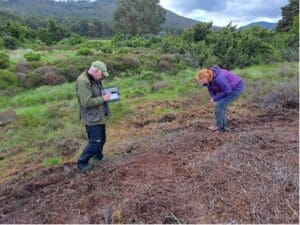
- After: Annual monitoring of the sites has already begun by a team of local volunteers.
-

- After – We have already noticed an increase in natural regeneration with tiny pine seedlings, blaeberry, cowberry, and cow wheat spotted.