Background
Countryside Learning Scotland is an award-winning charity with a commitment to sustain a thriving countryside and take pride in opening up opportunities across all rural-related activities and industries, nurturing future countryside custodians.
The charity’s “Pathways to Rural Work” initiative is a progressive programme that increases awareness of and access to rural participation opportunities, qualifications, training and careers to help reduce the attainment gap through providing greater school to work transition opportunities for pupils and students from all backgrounds and abilities.

The Project
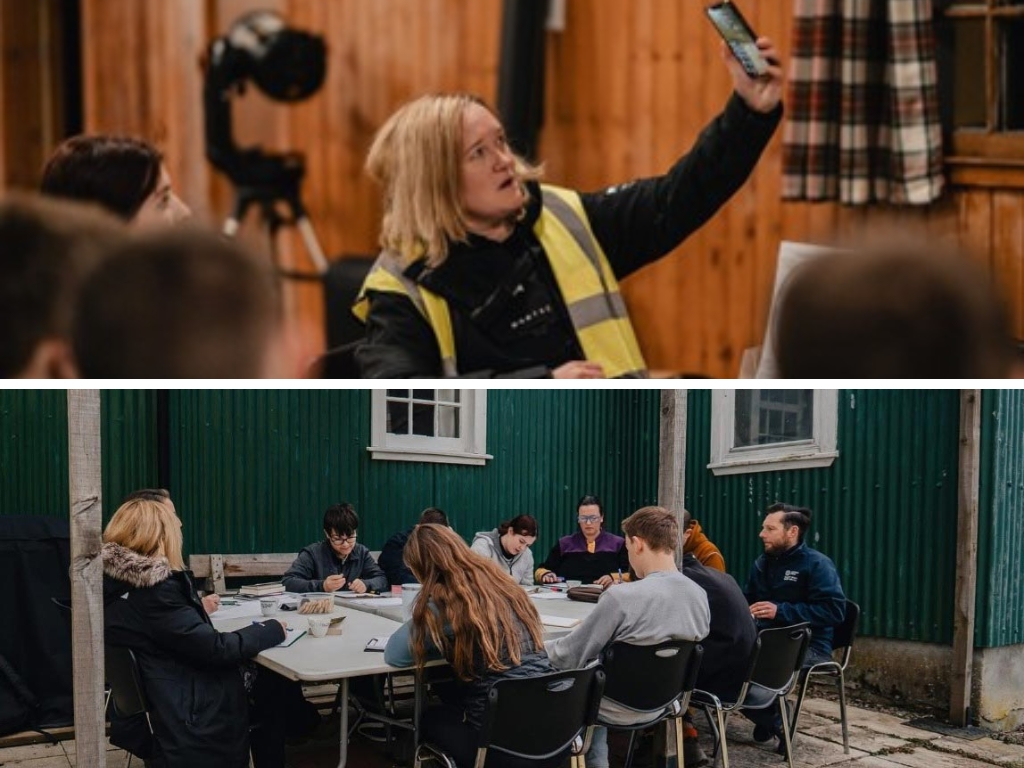
Countryside Learning Scotland the Crown Estate Scotland (Glenlivet) organised The Dark Skies Project for an S3 geography class from Speyside High School. The 13 pupils explored how the dark skies impact out-of-season tourism in their local area of Tomintoul and Glenlivet, and the benefits/impacts on the local environment and economy.
Head ranger Mark Johnston delivered an introductory class talk on the significance of dark skies alongside Beth Thom, the CLS regional coordinator, who spoke about related careers. In February 2025, the class took a trip to the estate and explored the Dark Skies Discovery Centre with the heritage ranger Lydia. They also interviewed local hospitality business owners to investigate the ways in which tourism is influenced by the dark skies park.
The project finished with an overnight trip in March, where the pupils took part in various activities which enhanced their understanding of the dark skies, as well as linking to the Curriculum for Excellence in subjects such as geography, physics, history, biology, and English. These included
- Outdoor mindfulness session and adjusting to darkness
- Bat Detecting and learning about bat ecology
- Night Sky Session with Sam and Lydia (Looking at meteorites, measuring light pollution, laser and telescope session)
- Nighttime nature & heritage walk to the graveyard – examining different types of lichen and trees, considering the history of the area
- Geography session on land uses and related careers
- Creative writing workshop with Dark Skies author Anna Levin
Challenges
Transport costs and finding funding to allow school groups to participate in trips or class visits is the main challenge that the regional coordinator faces in the Cairngorms. In schools which have access to their own minibus, this issue is mitigated as the only cost incurred is the fuel at £0.45/mile. However, booking buses for school groups can be extremely expensive, even for a short journey. This is a significant limitation to the projects that the regional coordinator can organise for the schools, and often the more successful projects are those taking place on school grounds.
Accordingly, the regional coordinator hopes to continue developing innovative ways to engage pupils within the Cairngorms National Park in the Pathways to Rural Work Programme via technology, as well as by utilising the outdoor spaces within walking distance of the school, to eliminate the barriers that both transport and staff shortages pose.
These challenges were tackled by starting the project with a school visit, instead of taking pupils out of the classroom. For the class visits to Glenlivet Estate, a minibus was hired through Moray Council by the school and driven by the teacher to keep costs down.
Impact
Feedback on the project has been incredibly positive from pupils who participated in it. When asked ‘what did you learn?’ one pupil responded “there is lots of dark skies parks around the world and I also learned that there are so many jobs/industries that can limit their light pollution”, with another stating “the impact of Dark Skies on community and biodiversity”. This demonstrates the effectiveness of the project which taught the pupils about something completely new and unique, which has not only a local impact, but national and international, too.
The funding allowed us to pay for transport to get the school group to the dark skies park to fully experience what makes the dark skies so impactful and magical beyond the classroom. Being immersed in the darkness is the only way to truly appreciate why preserving our dark skies is so important.
The project would not have gone ahead without the Cairngorms Trust funding, which funded Beth’s role and her delivery of the project.